Medieval James Himself

Medieval James Himself
Guide at Ozark Medieval Fortress

Saturday, January 29, 2011

Medieval Needles

“Did they have sewing needles in the Middle AgJan29 (17)bwes?”  Absolutely!  The first sewing needles were made from thorns or animal quills.  Later needles were made from bone.  The oldest known bone needle is estimated to be about 25,000 years old and was found in France.  Copper and bronze were used to make needles in ancient Egypt and one dating back to the 3rd Century B.C. was found in Germany.  With the advent of the Iron Age, the Romans made needles of iron.  All these materials were available to people of Northern Europe in 1226, the date of the Ozark Medieval Fortress.  Like today, however, the quality of the tools a person has depends upon how rich he is.  In the Middle Ages, the wealthy had metal needles and the peasants had thorn or bone needles.  Native Americans used porcupine quills and bone needles.  By the time of colonial America, needles were metal and highly valued.

Jan29 (12) Bone needles are hard to make.  I wanted to have some authentic needles and, in the Ozarks, the locust tree is a great supply of thorns.  My grandson, Christian, helped me harvest thorns, drill eyes, and hone any rough spots on the needles.  This proved to be a practical way to make needles.  Of course, as is the case with the bone needles, they are fragile and most fabric needs to be pre-pierced with holes using an awl before stitching. 

At the Ozark Medieval Fortress, our Good Wife has bone needles made for her by a good friend and extremely valued by her.  Nevertheless, she enthusiastically passes them around to guests on the tour for personal examination.  Look for them at the Wool Cottage, a recommended stop for any visitor to the castle.

Wednesday, January 26, 2011

Kids At the Ozark Medieval Fortress

“What is there for kids to do at the Ozark Medieval Fortress?”  I’ve been asked this at the gift shop before the tour as well as off property.  The first thing that comes to mind is to say “Everything”, because, basically, the only rule we have is to not go up on the castle walls.  I usually explain, however, that besides the chance to go inside a castle courtyard, speak with the masons that work on the walls and see the tread wheel crane in action, there are artisans and other special things to see and do.  Most are obvious from the public brochures or ads, but I like to make a special mention of two.  Those are the Good Wife and stone carvers. 

Sept25 (18)Kids especially love visiting the wool  cottage at the farm.  They learn about Medieval family life, livestock and commerce without realizing that they are doing anything except having fun.  There are sheep to feed, wool to spin on a drop spindle and the Good Wife to visit with at her cauldron or loom.  There is also a special opportunity to make a bracelet of wool gathered from our resident sheep.  I am always pleased to see the young people get so involved and have so much fun while learning about these important aspects of Medieval history.

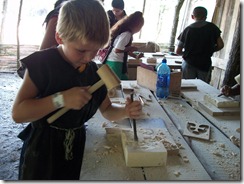
Kids also not only enjoy watching the stone July14 (33)carvers at work, but have the opportunity to take home a stone that they get to carve.  Stone carving classes are held throughout the day for kids or adults who want to try their hand at this essential castle building skill.  These classes are taught by one of our stone carvers who are usually busy carving stones for the castle itself.  While learning to carve a design of their choice, guests are free to ask questions about the history and tools of stone carvers of the Middle Ages.
For some strange reason, though, no matter how good the people and activities going on at the Ozark Medieval Fortress, the horse always seems to be the most popular with children.  But that would the same, I think, whether we were in France in 1226 or Arkansas in the 21st century.  Some things never change.

Monday, January 24, 2011

Medieval Cauldrons

Sept16 (40)On tour at the Ozark Medieval Fortress farm/wool cottage, people often ask about the cauldron being associated with witches and whether this is because of the Dark Ages.  This was particularly the case because our map labeled this area as the “Good Witch”.  That is the traditional French translation, but it would more accurately for us be “Good Wife”.  It is absolutely true that cauldrons have been used in non-Christian ritual and the Dark Ages (first half of the Medieval period) was a time of change in Northern Europe from pagan to Christian.  A cauldron, by the way, is defined as “a large pot used for boiling”.  It was difficult to make and, therefore, very valuable, especially because it was not just a status symbol, but rather a very useful tool.  Ancient “cauldrons” were made by potters, but by the Medieval they were made of metal whether cast or hammered (forged).  The oldest one in Europe was silver found in Denmark.  They have been copper, brass and iron.  In the Middle Ages, as today, the most common are cast iron.  A cauldron is large as well as heavy, and therefore usually has a heavy handle, which means it can be suspended over an open flame.  It is not hard to see why it was so valuable to women in the Medieval time.  In fact, it was valued in America in our colonies and the pioneer West where it was used for cooking, dying and soap making as well as laundry.

Jan24 (5)bwAt the Ozark Medieval Fortress the Good Wife does not use the cauldron for cooking.  It is used as a necessary part of the preparation and use of dyes on textiles.  Raw spun wool, tunics and hats were all dyed using natural dyes.  Even today large cauldrons are hard to find and expensive.  In 2010, the cauldron at Ozark Medieval Fortress was on loan from me.  Because it was such a big part of Medieval life, so practical, and involved metalworking, I wanted to see how hard it would be to make them.  I made two and have to say I see now why they are hard to find!

We have to remember that although they may make us think of witches, cauldrons were and are much more a practical part of daily life and history.

Saturday, January 22, 2011

Medieval Canteen


Aug31 (77)

“What did people in the Middle Ages use for a water bottle?”  You can tell that this is a summer question and almost everyone on tour had a plastic bottle of water with them.  In the Middle Ages the most common water “bottle” was made by the potter, but there were some made of leather or wood.  The same applied to cups or tankards at table.  In some places, thick leather was more popular than pottery and in the North, cups were sometimes made from animal horns. 

At the Ozark Medieval Fortress, the most popular water carrier is pottery that is even self-cooling!  Amazing but true.  This is done by not glazing the jug so that some of the moisture evaporates through the porous vessel and this evaporation makes it self-cooling. 

Pictured with a “Medieval Canteen” is Rasmus, who volunteered at the Ozark Medieval Fortress for the summer 2010 season and came all the way from Denmark.  The canteen shown was made and decorated by him at the potter’s hut.  Speaking of Denmark, that country has the oldest national flag in the world, dating back to 1218 (eight years before our castle’s Medieval date of 1226).

Thursday, January 20, 2011

International Blacksmith Shop

“How did the Ozark Medieval Fortress outfit a Medieval blacksmith shop in modern day Arkansas?”  It wasn’t easy!  The French investors had the benefit of their past experience at the Guedelon castle in France and their extensive collection of Medieval smithy tools, supplies and wheeled-carts.  The aAug26 (46)nvil, brought from France, is a particular treasure.  The bellows were also brought from France and the forge was built with stone from the quarry on site in an authentic manner.  The sharpening stone was carved at the stone carving hut, again from rock on site.  The post vise, which came from my collection, was from an old Amish blacksmith who told me his family brought it from Germany.  At the start of the season, the hand tools were all from France, but in the nature of a blacksmith shop, more tools were made here. 


Aug17 (36)Be sure to visit the blacksmith shop while at the Ozark Medieval Fortress.  Guests get to watch the smith in action and direct specific questions to him.  As in Medieval times, our smithy is near the castle and an important part of castle life.

Wednesday, January 19, 2011

Do We Speak English?

“Is the tour at the Ozark Medieval Fortress done with ‘thee’s’ and ‘thou’s’ and Old English like at the Renaissance fairs?”  Nope!  All the signs and the tour are done in modern American English.  We do get a lot of guests that visit in costume and some come Medieval and some come dressed in Renaissance era.  That makes it more fun, but a lot of people would have trouble understanding us if we used Old English, especially our foreign guests.  It is important to remember that those are different times and English changed from the beginning of the Middle Ages even to the end of the Renaissance.  For example, Medieval English is like this: Sept21 (4)

    “And I hym folwed, and hyt forth wente
      Doun by a floury grene wente.”

This is an excerpt from Medieval Chaucer and a “grene wente” is a green path.  Not many guests care to read or speak English from the Middle Ages.  If you have a time machine and are going back to 1226 in Europe, you are better off knowing Latin than modern English, German, or French.  We have an excellent collection of informative signs along the trail to maximize the educational benefit of a visit to the Ozark Medieval Fortress and to my great relief, the tour is in American English.  

Sunday, January 16, 2011

It’s The Pits

 Oct20 (13)b

“What’s the big wooden frame next to the carpenter’s shop for?”  Or another question often asked at the Ozark Medieval Fortress is “Did they have heavy metal saws in the Middle Ages?”  You bet they had saws and, again, we have to say “Good job” to the Roman empire.  The Romans gave us the sophisticated steel that they used not only for their legendary swords and spears, but they also made good steel saws.  Also, they developed the hand brace (drill) and auger popular through the World War II era.  The heavy saws were used to “rip” (cut lengthwise) logs into boards.  The heavy wooden frame so visible at the Ozark Medieval Fortress is an authentic recreation of the elevated frames often built for the use of the heavy saws.  Because they were often used over a dug out pit to make room for the man below, they are most commonly called “pit saws”. 

Pit saws were used extensively in the Americas.  They were state of the art until the introduction of the circular saw blade by the British in the 1800’s.  During the Middle Ages in the 1200’s, Europe also saw the introduction of the windmill.  In most places they were only used for grinding grain.  In Northern Europe, particularly Holland, they were also used to power pit saws.  The Dutch are smart and ended up with a surplus of boards, which they used to build ships.  Clever.  As a result, at the end of the Middle Ages, with the coming of the Age of Discovery, they had a big fleet and ended up with a world empire, largely because of the power of the windmill combined with the power of the pit saw!

At the Ozark Medieval Fortress, the pit saw frame was built by our carpenters and the boards they cut will be used in the castle projects. Pictured we see Juan and Si in action with the pit saw.