Medieval James Himself

Medieval James Himself
Guide at Ozark Medieval Fortress

Sunday, May 15, 2011

Medieval Stone: Quarry to Castle

May14 (3)On tour at the Ozark Medieval Fortress many guests have asked about the quarry and if it is big enough to provide all the rocks for the castle and how the stone is quarried and carried to the castle site.

A first look at the wall of limestone at the quarry shows how beautiful the Arkansas grey-white stone looks.  This is because May5 (17)the limestone has magnesium and is actually called dolostone.  It  is a hard limestone that is perfect for the castle.  It does mean a  lot of extra work for the blacksmith to keep the chisels sharp and make the metal wedges for the quarrymen.  A first look also makes the quarry seem small because the castle project is so big.  It takes a lot of stone to build a castle, but using techniques from 1226, the rocks are not needed all at once and there is no worry about running out of rocks in the Ozarks. 
The committee of French Medieval historians who are the authenticators for the castle authorized in the beginning (in 2009) the use modern drills and explosives under United States specifications to open the quarry.  That can be seen in the drill holes which are large Sept2 (34)and far apart.  In the Medieval to drill the holes, the quarrymen used a metal star bit, like a long chisel drill, which was struck with a mallet, turned, then struck again.  This bit was as thick as a man’s thumb - not 2-½” across like a modern drill.  Also, in the Middle Ages the drill holes would be one “hand” (4”) apart.  The holes could be either filled with water to freeze over the winter, or filled with packed dry wood then watered for expansion, or split away with wedges pounded into the fissures.  The historians’ authorization saved a year’s work just on preparations in the quarry.
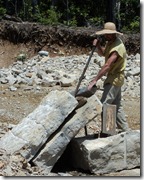
May14 (8) The large blocks of stone that were initially loosened from the cliff side were broken into slabs approximately one “span” (6-8”) thick.  This was done by following the sedimentary lines of natural weakness in the stone.  First, wedges were driven into the cracks and then metal rods were used to complete the break.  Those slabs were then turned into usable and moveable stone for the castle wall.  The largest were used for the first lintel stones over doors as well as the anchor stones in the wall.  Large stones continue to be used as the anchor stones as well as the rough stones for the stone carvers to turn  into specialty pieces around the doors and arrow loops.  The slabs are also split into face stones for the castle using a French tool called a “chase masse”, a Medieval French stone cutting tool which looks like a hammer but is not.  One side is placed against the rock and the other side is then struck with a hammer.  This causes a series of shock waves to go through the rock and split it.

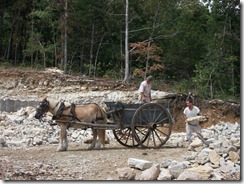
May4 (36) The rocks that are man-sized, which means the size one man can lift,  are loaded into a large wheeled horse cart for transport to the castle.  Larger stones are rolled onto a wooden sled and then dragged where needed by the horse and carter.  All this takes teamwork between the quarrymen, masons, stone carvers, carter and, of course, the horse. 

May4 (34) Once the stone is at the wall, the workers at the Ozark Medieval Fortress, like those of the Middle Ages, have the choice of using the Roman tread wheel crane to lift the stone or the use of ramps.  Even though the crane is amazing and will be necessary in the future as the walls get taller, ramps are preferred by the men because if a rope breaks the consequences are much less if the big stone is on a ramp.  The ramps are also much easier to move to where they are needed.  The large stones are a lot of work to move and downright scary to fingers and toes, but make the castle stronger and are worth the extra effort and danger. 

Once on the wall the various sized stones are arranged by May14 (12)the masons for the proper alignment.  It looks like a jigsaw puzzle.  Their skills are impressive.  They have to be aware of the shape, strength and interlocking connections of each stone.  They use some as face stones that show to the outside, some as anchor stones that show but also reach into the wall to tie it together, and some as fill and leveling stones.  When they have it all set up, they still have to come back and mortar it together.  They must be sure the wall is not only level on top, but plumb on both the inside and the outside.  That means that each stone had to first be split from the quarry cliff wall, then split into a slab, then broken into a usable stone, then lifted into the wagon or sled, then hauled and lifted out, then lifted or dragged up to the top of the wall and finally available for the mason to move into place, arrange or rearrange and then

Monday, May 2, 2011

Medieval Roof Tiles

Although the Ozark Medieval Fortress is in the process oMarch31 (4)f building walls, many guests are intrigued by the prospect of the work necessary for the future roofs.  Maybe this is because last year and this year have been rainy, but it may be because even a first look at the painting of the 2030 completed castle makes the roof seem like a daunting job.  It is.  This is not just because of the 12,000 tile that will have to be made by the potter, it is also because of the wooden framework the carpenters will have to build.  That framework will be on top of the 45 to 70-foot high stone tower walls. It will be steep, dangerous and will require meticulous measurements to keep the rows of tile straight.

April10Too (4)Fired clay roof tiles were well established as the standard castle roof in Medieval France.  They go back to the ancient Greeks who used tile in an “S” shape.  Clay tiles were expensive but fireproof, so a better choice than thatch.  The Romans also used clay tile and the French word for tile, “tuile” came from the Latin “tegula” meaning roof tile.  The Romans used an arched tile curved by the potters over their leg or a log. 

Clay tiles are heavy and, therefore, the stone walls of Greek temples, Roman buildings and Medieval castles were necessary for the strength needed to support them. 

The Medieval French style of tile is flat, or April10Too (3)“beaver tail” shingle.  This is the kind being made at the Ozark Medieval Fortress.  The clay is placed in a mold and the potter fashions a “hook” at the top which will grasp the board of the framework.  Pictured is a tile in such a form as well as a photograph of fired, finished roof tile on a sample section of roof framework.  They are not nailed.  There are no holes for rope to lash them to each other or the framework.  There will be no glue.  Their own weight and interlocking design will keep them in place.  The roof, of course, will seem steep by modern standards and cannot be walked on. 

Roofing companies still use authentic clay tiles and imitations because clay roof tiles create a quality, fireproof roof.  They are not common, however, because of their cost.  Still, it is good to remember that although the hand made tiles were a lot of work, they have lasted in the weather of Europe for hundreds of years.

Wednesday, April 27, 2011

Medieval Paper Making

The tour at the Ozark Medieval Fortress our first year of 2010 only mentioned the significance of paper making to the Medieval world, but in 2011 we are adding a paper making factory and have a complete model of a water wheel powered paper making factory of the Middle Ages.  As a guide, I think this is very worthwhile.  We tend to forget the importance of the little things in our lives.  Paper was as important an innovation during the Medieval as smart phones have been to us. 

April27 (1)bThis development at the Ozark Medieval Fortress is the result of the efforts of Jean Marc Mirat.  In fact, he is one of the founding investors and man, together with his wife Solange, who invited the French to come to Arkansas with this project.  Pictured is Jean Marc with the detailed historical model of the Medieval paper factory that he meticulously built.  This is the type of living history that is a valued aspect of the Ozark Medieval Fortress.

April27 (28) In Europe before the Middle Ages and the introduction of paper, documents were on parchment, which is thin animal skin.  That made it expensive and time consuming and manuscripts are rare.  With the coming of paper, historians have the benefit of a much more complete look at life in the Medieval.  Instead of an occasional legal or religious document, there are thousands of surviving papers from the Middle Ages.  This includes financial legers, correspondence, poems, literary writings, instructions on such common things as the way to best spread manure and even love letters. 

April27 (17) Papermaking began in China and spread to the East.  It came to Europe in the 10th Century through the Muslim world.  This early paper was made from crushed linen rags.  The first confirmed paper in Western Europe was a deed dated 1102 in Sicily.  Papermaking spread from Italy to Burgundy to France and then England.  One of the earliest paper factories was in the Herault district of France in 1189.

Paper started out as being crushed linen rags, but tApril27 (15)he Europeans found that it was more practical to crush bark or wood pulp.  The fibers are mashed into a vat of water to form a slurry like a vanilla milk shake.  The pulp is transferred from the vats to flat molds made of a wooden frame and a fine screen.  A press is used to flatten the fibers, cause them to stick together like felt and drain moisture.  As the sheets dry they can be placed in stacks with felt between or they can be directly hung to dry like clothes on a line.  This sounds like a very involved process, but once the equipment is in place and running, it can be very efficient.  It was definitely an improvement over processing parchment animal skin!

April27 (18)In addition to the details of the paper making itself, it is important to consider the resulting impact on life in the Middle Ages.  We now have email, cell phones and texting, but the people of the Medieval witnessed the beginning of the widespread written word .  Remember, however, that it was still handwritten.  The movable Gutenberg press did not appear until 1451, late in the Middle Ages.  The addition of a papermaking factory is an exciting expansion at the Ozark Medieval Fortress.

Saturday, April 23, 2011

Medieval Arrow Loops

At the Ozark Medieval Fortress many guests have askAug28 (10)bed about the purpose and background of the narrow windows located at waist height.  These windows are called arrow loops, firing loop holes, or, for the French, “meurtrieres”.  Their purpose is primarily to allow archers and later crossbowmen to shoot from inside the lower level of the wall even though most of the fighting was done from the top of the wall, called the battlements.  These windows are very narrow on the outside (most castles, like the Ozark Medieval Fortress, have the outer width one “hand”, which is four inches.  On the inside of the wall, these windows widen to allow a greater field of fire to the right or left.  As crossbows became more popular during the 1200‘s, the arrow loops became even wider on the inside because of the crossbow’s horizontal shape.  This is the design of the arrow loops at the Ozark Medieval Fortress, which is dated 1226.

There were arrow loops used in Greece and Byzantium before Christ and in Rome in April14 (3)the 300’s, but those were generally in fortifications adjacent to harbors to permit shooting at attacking ships.  Arrow loops were not common in the castles of Western Europe until the 1100’s.  At first they were just vertical slits like those found in the ancient world.  Although the simple vertical slit continued to be used throughout the Medieval, many castles in Europe modified the shape to add a horizontal slit in various positions along the vertical slit.  A Christian cross shape proved to be the most popular, but sometimes a simple circle at the top or bottom was used.  At the Ozark Medieval Fortress the Master Mason has elected to use the traditional vertical arrow loop.Sept4 (83)

The term “loophole” likely comes from the old French word “loupe” meaning “opening” or old German “lupen” meaning “to peer out”.  It is a narrow opening at the outer wall to make it harder for the enemy to shoot in.  Later, because of the narrowness of the arrow slit opening, a narrow opening in a law became known as a “loophole”.

Monday, April 18, 2011

Medieval Furniture

Although the tour at the Ozark Medieval Fortress is outdoors and the castle is under construction, guests have nevertheless asked: Oct20 (13)b“What kind of furniture did they have in the Middle Ages?”  Basically their furniture was like that of our early colonial times on the eastern frontier.  Most of it was oak.  All of it except special items for the very rich was very plain but practical.  A flat board in the Middle Ages had to be either split and smoothed or hewn with an axe and smoothed or painstakingly cut with a pit saw and smoothed.  My point is that finishing the oak to the point where people didn’t get slivers was a lot of work. 

People of the Medieval had no excess furniture.  A basic chest of wood was much valued over keeping possessions in a basket.  The early chests were made of hollowed logs or tree trunks and, therefore became known as “trunks”.  Beds were made of heavy boards raised off the floor on low trestles or on logs, with straw filled mattresses.  Later the Normans developed the enclosed, curtained bed that predated the four-poster beds.  The curtains were for providing warmth and privacy. 

April2Too (25)Tables were also made of flat oak boards, primarily set on trestles as well.  A trestle could be made like a modern saw horse to allow for the table to be easily moved or stored away.  This was especially the case in the Great Hall.  Otherwise, it was common to build the table with the legs or “trestles” attached.  This would be the case in places like the kitchen, workshops or at the community oven.  At the Ozark Medieval Fortress this is the type of trestle table seen.  Similarly, benches were made like the table with shorter legs.  Even though the furniture was simple, the carpentry work was carefully done to make the pieces strong and durable.  Mortise and tenon joints, lap joints and dove-tail joints with wooden pegs all provided reliability.  Stools and benches were the rule: chairs were the exception.  April14 (12)

At the Ozark Medieval Fortress, the carpenters have made tables and benches in the Medieval style for outdoor use by our guests.  Later, as the castle nears completion, they will be busy making interior furnishings.  Even before that can be done, however, many oak boards will have to be sawed and carefully prepared for floors, roof beams and doors.
There is a lot more to building a castle than first meets the eye!

Monday, April 11, 2011

Medieval Forest Management

Most of the trail at the Ozark Medieval Fortress goes through the woods and guests often ask about the forest and hunting laws of the Middle Ages.  The woodcutters at the Castle also follow the Medieval practice of leaving brush piles in the forest and many guests ask about that as well.  The piles of brush are authentic because the people of the Middle Ages knew very well that in the winter times of snow it was much better to have rabbit stew than acorns to eat.  The brush piles were habitat for small wildlife such as rabbits,  pheasants and the like. 

April2Too (5)Peasants were allowed to clear brush, but not cut trees down.  They could take branches off trees only as high as they could reach.  As a result, the innovative and practical people developed the parrot’s beak brush cutting tool on a pole to extend their reach.  Sometimes called a “brush ax” it was the forerunner of the halberd that became popular as a weapon in the late Middle Ages. 

William the Conqueror of Normandy, France May17 (78)started what became known as the Forest Law as separate from Common Law or Church Law.  This gave the king direct and ultimate authority over these lands and special courts were set up to administer the law.  Punishments for breaking the law were very harsh until Henry III signed the Forest Charter in 1217 (about the time of the date of the Ozark Medieval Fortress).  This began the practice of allowing peasants to hunt rabbits and other small game without punishment.  Very nice to have a king realize that it is bad to have fat game protected while the common people starve.

It is true that the forest as well as the animals belonged to the lord and permission July6 (5)was required to cut trees or hunt.  The forest was not just what we would consider woods, but included meadows and more open country if the lord so ordered.  Nevertheless, because so much of Europe was wooded in the Middle Ages, our idea of “forest” is not far off.  At the Ozark Medieval Fortress, a minimum number of trees have been cut to preserve the “feel” of the Medieval. 

Monday, April 4, 2011

Medieval Rope Making

One of the stops and demonstrations at the Ozark Medieval Fortress is the Rope March31 (14) Makers Hut.  Ropes were important to the construction of the castle in everything from small tool repair to measurement using the 13-knot rope to operating the tread wheel crane for lifting.  They were also used in daily life of the people for such things as belts, animal lead ropes, bucket handles, binding wheat sheaves, tying herbs, clotheslines and on and on.  In the Middle Ages, the people of Scandinavia frequently braided leather to make their rope, similar to what the Native Americans did.  For most of Europe, twisting fibers to make rope was the norm. 

April3 (9)Ropes go back to the ancient world as far back as we know.  The Egyptians developed the rope making tool and used water reed fibers to make their ropes.  Hemp, which is perhaps one of the most ideal fibers, was first used in China but other fibers were used.  Flax, which is the fiber used for clothes, was also used for rope.  They also used grass, hair and other fibrous plants.  In the Medieval small communities invariably had a rope maker and the shop would be similar to that at the Ozark Medieval Fortress.  In the cities, they made long buildings (up to 300 yards long) called “rope walks” to be able to make ropes for the ships that needed them without splices.

Fibers are dried and twisted to form a yarn.  March31 (12)The thin yarn is then twisted with other yarn to form a strand.  Strands are then twisted to form the rope.  Thin rope can be twisted to form heavier rope.  The twist of the strand is opposite the twist of the yarn, while the final rope is twisted opposite that of the strand.  It is the opposing twists that give the rope its internal binding and strength.  A twist to the left was called an “S” twist, and to the right a “Z” twist. 

Sept6 (42) The rope maker used a lot of fiber to make even a modest sized rope.  Rope makers were both men and women and often the entire family participated.  It was common also to barter for or purchase fiber and hemp was in demand.  At the Ozark Medieval Fortress current law keeps us from having hemp to make our ropes, so we use jute or sisal yarn that is purchased locally.  The rope making machinery is a joint effort of the blacksmith and carpenters.  Rope making does not require special skill nor is it dangerous and guests are encouraged to try their hand at it.

Like the ancient Egyptians, the rope making machine of the Middle Ages had two parts: a base with multiple March31 (11)cranks and a base with a single crank.  The bases are separated to the length of the rope being made.  Using a machine with multiple cranks allows the rope maker to go right from yarn to rope.  Each crank gets multiple yarns, which twist into strands as it is twisted into the rope.

To make a rope, start by tying the yarn to the single master crank.  Run the yarn through one of the multiple cranks, back to the master crank.  Repeat back to a different crank on the multiple side and April19Too (5)back again to the master.  It is most common to use three of the four multiple cranks.  A rope is stronger if all four cranks are used.  A moveable cross helps keep the yarn in alignment.  When the multiple cranks are turned to the right (with the sun), it twists the strands.  When the single, master crank is turned to the right, it is actually in the opposite direction from the other side and twists the strands into the rope.  It is that simple.  The trick, however, is to make the twists even and snug but not so tight that the rope breaks.  Easier said than done!  There are no motors and the entire process, though simple, takes a lot of time.  As a result, people of the Medieval appreciated even the basic blessing of a rope.